
Don't Fuck With Bees
A new pathway for AI by, for, and of people.

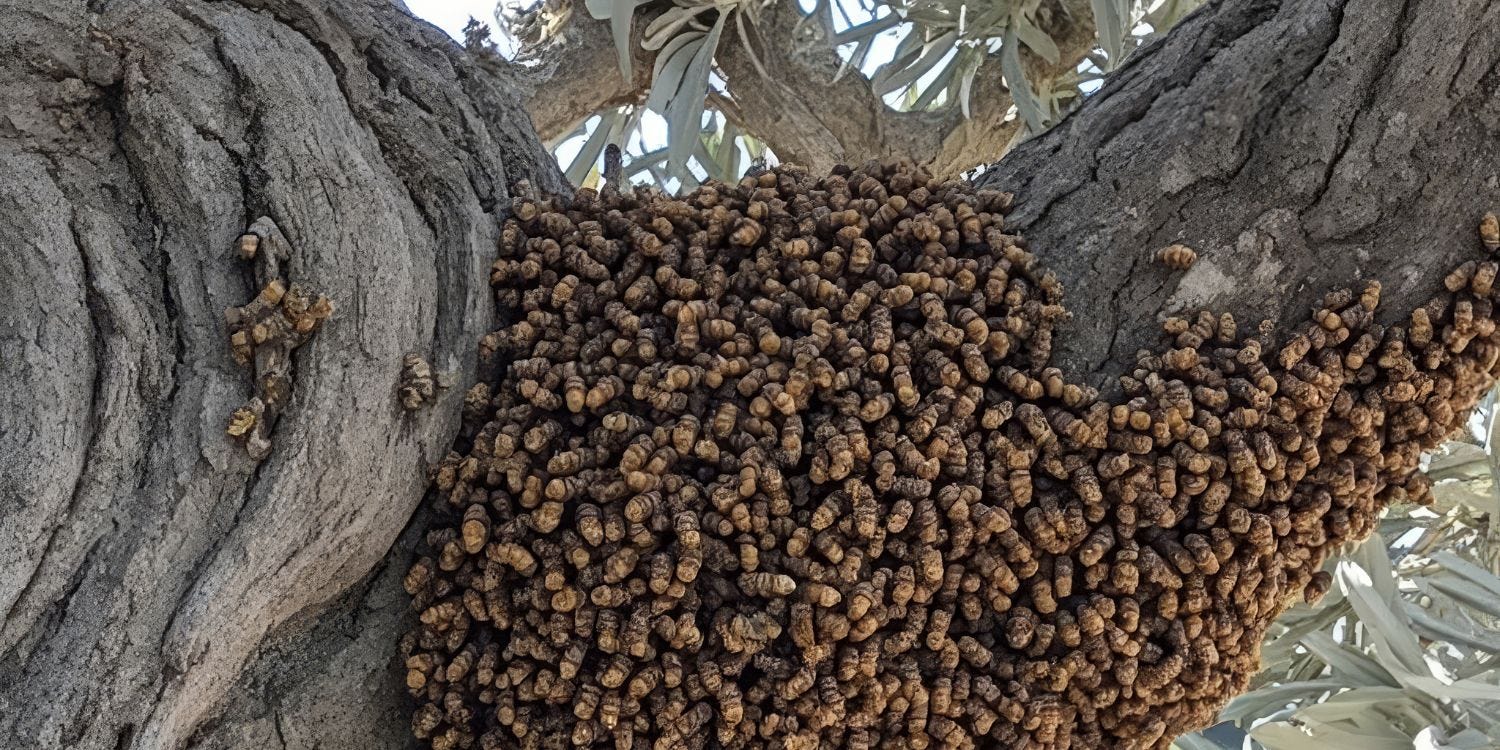
“Dad, today at camp, my friend and I found this bush with all these bees in it.
And we would hit it with a stick, and all the bees would come flying out.
And we would run away.”
There were a lot of things that went through my mind as I imagined two first-grade boys getting stung to death by a swarm of bees.
But only one thing came out of my mouth:
“Alexander, don’t fuck with bees.”
Now, I was never one to curse around my child or use foul language directed at him, but in that moment, it seemed to sum up what needed to be said.
His eyes got wide. He nodded and said, “Okay, Dad.”
He got the message.
I remember the first time I got stung.
It was in preschool, in Camarillo, California. I was on the slide in our playground, which backed up to a grove of olive trees.
I didn’t see the bee, but I must have pinned it between my arm and the slide.
It was a pain I’d never felt before.
I looked down at my arm. I saw something sticking out of it, the skin already swelling into a red lump.
I ran to my teacher, crying, telling her that my arm hurt.
She explained to me that I’d been stung by a bee. That bees do that when they get backed into a corner. They’re defending each other.
The stinger was still in my arm. She pulled it out gently and tended to me.
She told me the bee would fly off and die, that this was its last act of courage.
I learned my lesson.
And years later, I passed it down to my son:
Don’t fuck with bees.
⸻
Sometimes my purpose in life is to serve as a warning to others.
That’s the way we were designed to learn as humans through experience, and through the wisdom of people we trust.
AI is different. It doesn’t work that way.
The internet has skewed this even further. Americans report in a recent survey that they trust less than half of what they see and read online because of AI.
What can we do to re-anchor AI and the internet itself back to communities of trust?
This journey starts with Dotes.
So let’s look back at my experience in preschool.
How would we craft that as a Dote?
⸻
DOTE: The First Bee Sting
Do:
I got stung by a bee on the playground.
Observe:
I felt a sharp pain in my arm. It hurt a lot and made me cry. When I looked, I saw something sticking out and my arm was swelling. It surprised me.
Tell:
I was playing on the slide at preschool near some olive trees. I didn’t see the bee when I slid down. I pinned it by accident, and it stung me. I cried and ran to my teacher. She took out the stinger and told me the bee stung because it felt trapped. She also said the bee would fly away and die, which made me feel sad. I didn’t know bees did that.
Explore:
Next time, I will be careful and give bees lots of space. I also want to learn more about bees and what makes them sting.
Show:
If I had photos, they would show a bee, and my arm swelling from the sting.
But the pictures live in the memory and in the lesson passed down to my son:
Don’t fuck with bees.
⸻
When I told my son, “Don’t fuck with bees,” he knew exactly what I was saying.
Because when he nodded, he got a little smile on his face. And I knew that he understood.
But without the right context, without trust, without shared meaning, even simple statements like that could be confusing—or misunderstood entirely.
And that’s the real problem we’re facing now: semantic ambiguity.
Words can mean very different things depending on the context.
We, as humans, sort this out not just by pattern-matching words, but by trusting the person speaking to us, by understanding the relationship, and by drawing from lived experience.
AI doesn’t work that way.
Recent chatbots use large language models that analyze surrounding words and patterns to predict likely next words and generate responses.
But that’s not how we truly understand each other.
If we want to build a digital world that re-anchors meaning to lived experiences, we need to start with Dotes.
Because memory isn’t just about recording facts.
It’s about learning.
Not machine learning—human learning.
⸻
So, if I want to break things down and make them really clear, my mind goes to what I call Tarzan speak.
These are basic sentences. Simple, stripped down.
Maybe like talking to a pet—or, in this case, a computer.
I think about my early days programming on a TRS-80 Model 12 with 128K of memory.
I wrote a program to generate Dungeons & Dragons characters for my middle school friends, using very simple words to construct what were essentially just mathematical equations.
That’s what programming is.
That’s why programming languages were invented.
What if there was a language that could be the common denominator—not just between English speakers, but between people across the globe and AI?
Turns out, there is.
There’s a language specifically designed to help us say, “Me Tarzan, you Jane,” without ambiguity.
That language is called Mirad.
⸻
My friend Jamie Shoemaker has been working on this for years.
He was a linguist with the NSA, and I knew from the moment he introduced me to Mirad several years ago that it was going to be important for the future of digital society.
This is where things start to get complex.
It’s a lot to explain.
But essentially, it goes like this:
We can train a new class of AI that I call implication models.
This is human-centric AI that doesn’t just put people in the middle—it puts us in the loop and in charge.
It’s trained on our experiences.
It’s our AI.
AI by, for, and of people.
And it allows us to move beyond the limitations of the AI models we have today.
It shifts from inference to implication.
I’ve written a paper about this. It’s about how we chart a different pathway for AI.
Our only chance against AI out of control is with AI that works for us.
In the days since sharing the report, I’ve received thoughtful questions about the who, how, and why behind implication models and human-centric AI.
Let me explain.
No—there is too much.
Let me sum up.
It all comes down to this:
Gameshow is an Everyone App to build your AI Rep for school, work, and life.
AI is becoming part of everything, but most people still interact with it passively. Gameshow flips the script. It will help you create and shape an AI Rep that reflects you—your choices, your values, your learning journey. Through interactive play and guided reflection, you will train your Rep to become a digital companion that grows alongside you, in school, in your career, and in everyday life.
This isn’t about building AI for AI’s sake.
It’s about building with AI, so that you—and every person—can shape your digital future, not be shaped by it.
⸻
Where I’m really at right now.
I’ll be honest. This isn’t just a vision I’m casually working on.
This is the thing I’ve spent years building toward — and I’m now at the edge.
This will either happen, or it won’t.
I am well past the point of comfort. Past safe.
I’m at the place where this either becomes real because others step up, or it dies quietly because the right people never saw it in time.
I need help.
Not theoretical, not someday. Now.
I need people who get this, or are willing to try.
People who care enough about the future of AI, learning, governance, and what it means to be human, to help push this forward.
That means funders.
That means builders.
That means allies who can open doors.
That means people who will stand beside this work when it’s still fragile, still early, still becoming.
I don’t care what category you fall into.
If you read this and feel that pull — that “this matters” — then please reach out.
Because the truth is, this doesn’t move forward without you.
> Read the paper and contact me directly
Beyond Inference: Implication Models and the Future of Human-Centric AI
> Share this with the person you know who will get it
> Subscribe and stay close — because the next step is coming fast
When I was a kid, the youngest of six boys, my brothers taught me to ride a bike by putting me on a bike, giving me a shove and letting go. I stayed upright long enough to crash into a bush that came fully loaded with a wasp's nest. Don't fuck with wasps, I learned. In the same way you shared DOTE I can trace, some 60 years later, the exact same learning steps, conclusions drawn and warnings onboarded. And now, I am off to do my Saturday long distance bike ride. Will be thinking about AI built by humans for humans. (Oh yes, my oldest brother has been a bee keeper and honey producer here in Hawaiʻi for over 50 years. I have never known the bees to fuck with Charlie.) ~ Josh Reppun 🌈🌱